
Home · Learn · Calculateur et formule de clé de contrôle UPC
Calculateur et formule de clé de contrôle UPC
Le 12e chiffre d'un code-barres UPC-A est une somme de contrôle qui détecte les erreurs de scan. Voici exactement comment il est calculé, avec exemples résolus — et notre générateur le calcule automatiquement quand vous saisissez les 11 premiers chiffres.
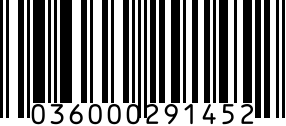
Chaque code-barres UPC-A se termine par une clé de contrôle — le 12e chiffre, calculé à partir des 11 premiers. Son but : attraper les erreurs de transposition d'un chiffre quand des humains saisissent des codes-barres. Si le caissier ou le magasinier tape un chiffre faux, la clé de contrôle ne correspondra pas et le système rejette la saisie. EAN-13 (13e chiffre) et EAN-8 (8e chiffre) fonctionnent pareil avec la même formule.
Vous n'avez presque jamais besoin de calculer la clé à la main — tout générateur de code-barres (dont le nôtre) le fait pour vous à la saisie des 11 premiers chiffres. Mais comprendre le calcul est utile pour déboguer une erreur « GTIN invalide » d'Amazon ou Walmart, ou vérifier un UPC tiré d'une base de données.
La formule de clé de contrôle GS1 Mod 10
Étape 1 : prenez les 11 premiers chiffres de l'UPC. Étape 2 : multipliez les chiffres de position impaire (1er, 3e, 5e, 7e, 9e, 11e — de gauche à droite) par 3, multipliez les chiffres de position paire (2e, 4e, 6e, 8e, 10e) par 1. Étape 3 : additionnez tous les produits. Étape 4 : trouvez le plus petit nombre qui, ajouté à la somme, donne un multiple de 10. Ce nombre est votre clé de contrôle. Algébriquement : clé = (10 − (somme mod 10)) mod 10. Le double « mod 10 » gère le cas limite où somme mod 10 = 0 (la clé est 0, pas 10).
Exemple résolu 1 : UPC 03600029145?
Onze chiffres : 0, 3, 6, 0, 0, 0, 2, 9, 1, 4, 5. Positions impaires (×3) : 0+6+0+2+1+5 = 14, ×3 = 42. Positions paires (×1) : 3+0+0+9+4 = 16. Somme = 42 + 16 = 58. Prochain multiple de 10 : 60. Clé = 60 − 58 = 2. UPC complet : 036000291452. C'est un vrai UPC de papier toilette Charmin Ultra Strong — scannez-le sur Amazon pour vérifier.
Exemple résolu 2 : UPC 01234567890?
Onze chiffres : 0, 1, 2, 3, 4, 5, 6, 7, 8, 9, 0. Positions impaires (×3) : 0+2+4+6+8+0 = 20, ×3 = 60. Positions paires (×1) : 1+3+5+7+9 = 25. Somme = 60 + 25 = 85. Prochain multiple de 10 : 90. Clé = 90 − 85 = 5. UPC complet : 012345678905. C'est l'« UPC d'exemple » canonique des tutoriels.
Exemple résolu 3 : quand la somme est déjà un multiple de 10
Onze chiffres : 8, 1, 4, 1, 4, 1, 0, 6, 0, 4, 9. Impairs (×3) : 8+4+4+0+0+9 = 25, ×3 = 75. Pairs (×1) : 1+1+1+6+4 = 13. Somme = 75 + 13 = 88. Prochain multiple de 10 : 90. Clé = 2. Complet : 814141060492. Essayez vous-même : chiffres 0,0,0,0,0,0,0,0,0,0,0 — somme impaire 0, somme paire 0, total 0, clé = (10 − 0) mod 10 = 0. L'UPC tout-zéro a une clé de 0.
EAN-13 et EAN-8 utilisent la même formule avec des poids de position différents
EAN-13 : prenez 12 chiffres, alternez ×1 et ×3 EN COMMENÇANT par ×1 depuis la GAUCHE (l'inverse d'UPC-A). EAN-8 : 7 chiffres, alternez ×3 et ×1 en commençant par ×3 depuis la gauche. ITF-14 : 13 chiffres, alternez ×3 et ×1 en commençant par ×3 depuis la gauche (même logique qu'EAN-8). Le modulo « mod 10 » est identique pour tous les formats — seule la pondération de position s'inverse. C'est pourquoi un UPC-A converti en GTIN-14 (ajout de deux zéros) garde la même clé — le motif de pondération se réaligne.
Quand la clé de contrôle seule ne suffit pas
La formule Mod 10 attrape toute erreur d'un chiffre et la plupart des transpositions de chiffres adjacents, mais PAS les échanges où les chiffres diffèrent de 5 (ex. 0↔5, 1↔6, 2↔7, 3↔8, 4↔9). Un opérateur de saisie pourrait taper 360200291452 au lieu de 036000291452 et la clé passerait quand même — donc « clé valide » est nécessaire mais pas suffisant. La couche de validation suivante est la consultation GS1 GEPIR : même avec une clé valide, le préfixe d'entreprise doit remonter à une entreprise licenciée. C'est ce que vérifient Amazon, Walmart et Target quand ils rejettent les soumissions « GTIN invalide ».
FAQ
Comment calcule-t-on une clé de contrôle UPC ?
Prenez les 11 premiers chiffres. Multipliez les chiffres de position impaire (1er, 3e, 5e, 7e, 9e, 11e depuis la gauche) par 3. Multipliez les chiffres de position paire (2e, 4e, 6e, 8e, 10e) par 1. Additionnez tous les produits. La clé est le plus petit nombre qui, ajouté à cette somme, produit un multiple de 10. Algébriquement : clé = (10 − (somme mod 10)) mod 10.
Quelle est la clé de contrôle de l'UPC 012345678905 ?
5. Les onze chiffres 01234567890 donnent une somme position impaire 0+2+4+6+8+0=20×3=60, somme position paire 1+3+5+7+9=25, total 85. Prochain multiple de 10 : 90. Clé = 90−85 = 5.
Pourquoi l'UPC a-t-il une clé de contrôle ?
Pour détecter les erreurs de saisie et de scan. La clé attrape toute faute d'un chiffre et la plupart des transpositions de chiffres adjacents (ex. taper 12 au lieu de 21). En caisse ou réception d'entrepôt, le scanner ou système de saisie rejette tout nombre à 12 chiffres dont la clé ne se calcule pas correctement depuis les 11 premiers — empêchant les mauvaises données d'entrer dans le système de stock.
La clé de contrôle EAN-13 se calcule-t-elle comme l'UPC ?
Presque. EAN-13 utilise le même algorithme Mod 10 mais alterne la pondération dans le sens OPPOSÉ — positions impaires ×1 et paires ×3 (UPC-A fait impaires ×3 et paires ×1). Le calcul revient équivalent car EAN-13 a 12 chiffres d'entrée et UPC-A 11. En convertissant UPC-A 012345678905 en GTIN-13 par ajout d'un zéro (0012345678905), la clé reste 5 — le motif de pondération se réaligne correctement.
Un UPC peut-il avoir une clé de contrôle de 0 ?
Oui. Quand la somme des produits pondérés est déjà un multiple exact de 10, la clé est 0 (pas 10). La formule (10 − (somme mod 10)) mod 10 gère ce cas limite. Exemple : un UPC à somme pondérée 80, prochain multiple 80 lui-même, clé = (10 − 0) mod 10 = 0.
Dois-je calculer la clé de contrôle moi-même ?
Non — chaque générateur de code-barres la calcule pour vous. Vous saisissez les 11 premiers chiffres (ou 12 pour EAN-13), le générateur ajoute la clé et rend le code-barres. Notre générateur le fait automatiquement ; pas besoin de taper la clé. Le calcul importe pour déboguer une erreur « GTIN invalide » ou vérifier un UPC tiré d'une base de données tierce.
Related generators
Need a real barcode now?
Generate a valid UPC-A barcode in seconds, no watermark. Free for casual use; paid plans from $9/mo for higher volume.