Home · Learn · What Is a SKU? Stock Keeping Units Explained
What Is a SKU? Stock Keeping Units Explained
SKU is your INTERNAL product code — you choose the format and what it means. UPC is the EXTERNAL code that the world uses to identify the same product. They're complementary, not interchangeable.
SKU stands for Stock Keeping Unit. It's a code your business creates internally to track a specific product variant in your inventory, warehouse, POS system, accounting software, and reports. The format is yours to choose — you decide the digits, letters, length, and meaning. Most SKUs encode useful information for your operations: product type, color, size, season, supplier, etc.
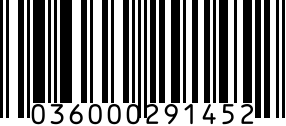
SKU is fundamentally different from UPC (Universal Product Code). UPC is the EXTERNAL identifier — a 12-digit code issued by GS1 that retailers worldwide use to identify your product at checkout. SKU is INTERNAL — only your business uses it. Most retailers track both: SKU for internal operations, UPC for external retailer/marketplace compatibility.
Typical SKU structures
SKUs encode meaning. A clothing retailer might use 'MEN-TSHIRT-RED-XL-S26' (gender + product + color + size + season). A wholesale distributor might use '47-BLUE-12PK-CA' (vendor 47 + color + pack size + warehouse). Amazon FBA sellers often use '[brand-abbrev]-[product]-[variant]'. There's no standard — the rule is internal consistency. Common length: 8-20 characters; common format: alphanumeric with dashes or underscores.
SKU vs UPC vs GTIN vs MPN — quick disambiguation
SKU = your internal code (free, your format). UPC = GS1's 12-digit retail code (paid, fixed format). GTIN = umbrella term for ALL GS1 identifiers — includes UPC (GTIN-12), EAN-13 (GTIN-13), GTIN-14 for cases. MPN = Manufacturer Part Number — typically the upstream manufacturer's identifier (e.g., Apple's MPN for the iPhone 15 is 'MR8X3LL/A'). A single product on Amazon has all four: SKU (your code), UPC (GS1's code), GTIN (Amazon API name for UPC), MPN (Apple's code for iPhones).
When you need each
SKU only: tiny operation, single sales channel, no third-party logistics. UPC + SKU: selling on Amazon, Shopify, Etsy, eBay, Walmart — UPC for marketplace identification, SKU for your inventory tracking. UPC + GTIN-14 + SKU: shipping cases to wholesale retailers — GTIN-14 on the outer carton (rendered as ITF-14), UPC on each retail unit inside, SKU in your warehouse management system. UPC + MPN + SKU: dropshipping or reselling — MPN identifies the upstream manufacturer's product, UPC identifies the retail SKU, SKU is your internal code.
How retailers expect SKU + UPC together
Most retail marketplaces accept SKU as the seller-facing identifier (what shows in your seller dashboard) and UPC as the buyer-facing identifier (what links the listing to other sellers of the same product). Amazon: 'Seller SKU' field is yours; 'Product ID' is UPC/EAN/ISBN/ASIN. Shopify: 'SKU' field is yours; barcode field holds UPC. Walmart Marketplace: 'Item SKU' is internal; 'UPC' / 'GTIN' is the global identifier. Etsy and eBay: SKU optional but recommended; UPC optional but rewarded with better search visibility.
FAQ
What does SKU stand for?
Stock Keeping Unit. It's a code your business creates internally to track a specific product variant in inventory, warehouse, POS, and accounting systems. Coined in the 1960s by IBM and adopted as the universal term for internal product codes.
Is a SKU the same as a barcode?
No. A SKU is your internal product code (you choose the format). A barcode is the visual representation of any identifier — UPC, EAN, Code 128, etc. You CAN render a SKU as a Code 128 barcode for internal warehouse use, but that's optional; SKUs work fine as plain text in databases and reports.
Is a SKU the same as a UPC?
No. SKU is internal (your format, your rules). UPC is external (GS1-issued 12-digit retail code). Most products have both: SKU for your inventory tracking, UPC for marketplace and retailer compatibility. Amazon's 'Seller SKU' and 'Product ID' fields hold them separately.
Do I need a SKU on Amazon?
Amazon assigns a generic 'Seller SKU' automatically if you don't provide one, but it's strongly recommended to provide your own — your internal code is the only reference back to your warehouse and accounting systems. The Amazon-auto-generated SKU is opaque and doesn't help you track inventory. Customize the SKU field during listing creation.
Can I just use the UPC as my SKU?
Technically yes — you can copy the 12-digit UPC into your SKU field. But the UPC encodes nothing useful for YOUR operations (it identifies the product to retailers, not to your warehouse). A meaningful SKU like 'TSHIRT-RED-XL-S26' is more useful internally than '012345678905'. Most sellers use both: UPC for external identification, SKU for internal tracking.
Should my SKU contain product attributes?
Yes, that's the whole point. Embed enough info to identify the product variant at a glance: 'STYLE-COLOR-SIZE' or 'CATEGORY-VENDOR-VARIANT'. Avoid encoding things that change frequently (price, supplier batch) since SKUs should be stable for life. Don't include personally-identifiable info or competitive intelligence (e.g., margin codes) since SKUs are often visible to customers.
Related generators
Need a real barcode now?
Generate a valid UPC-A barcode in seconds — no signup, no watermark. Free for casual use; paid plans from $9/mo for higher volume.