
Home · Learn · Qu'est-ce que le GS1 Digital Link ?
Qu'est-ce que le GS1 Digital Link ?
Le GS1 Digital Link encode votre GTIN dans une URL web ordinaire. Un QR code peut amener un consommateur à une page produit, envoyer un avis de rappel, OU se scanner en caisse de détail — même code, des lecteurs différents l'interprètent différemment.
Besoin d'un code QR ? Essayez le générateur de codes QR gratuit — liens, WiFi, vCard, etc.
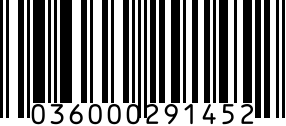
Le GS1 Digital Link est le standard GS1 pour représenter les GTIN (et autres identifiants GS1) comme des URL web HTTP standard. Au lieu d'un UPC à 12 chiffres encodé en code-barres 1D, le produit porte une URL comme « https://id.gs1.org/01/00614141123456 » encodée en QR Code ou Data Matrix. Scanner ce code avec une caméra de téléphone ouvre une page web montrant infos produit, ingrédients, avis de rappel, données de durabilité. Le scanner en caisse de détail extrait le GTIN « 00614141123456 » et le traite comme un code-barres ordinaire.
GS1 pousse vers « Sunrise 2027 » — un objectif de transition industrielle coordonné pour que les plus grandes marques mondiales ajoutent un QR 2D ou Data Matrix encodé en GS1 Digital Link à chaque produit de détail, à côté (ou remplaçant à terme) du code-barres 1D UPC traditionnel. En 2026, de grandes marques dont PepsiCo, Procter & Gamble, Nestlé et Walmart mènent des pilotes. La transition complète s'étale sur plusieurs années et ne se fera pas du jour au lendemain, mais la direction est fixée.
Comment le GS1 Digital Link encode les données
Le motif d'URL standard : https://[domaine]/[clé-AI-GS1]/[valeur]. Exemples : « /01/ » = GTIN, « /10/ » = numéro de batch/lot, « /17/ » = date de péremption, « /21/ » = numéro de série. Un produit pharma pourrait encoder « https://id.gs1.org/01/00614141123456/10/LOT789/17/281231/21/SN9876 » — une seule URL contenant GTIN + lot + péremption + série. Le domaine peut être le résolveur officiel de GS1 (id.gs1.org), le domaine propre de la marque (https://cocacola.com/01/...), ou tout gestionnaire enregistré. Les domaines détenus par la marque permettent de rediriger vers ses propres pages produit tout en restant un GS1 Digital Link valide.
Pourquoi les marques passent au GS1 Digital Link
Trois moteurs. (1) Engagement consommateur — scanner un UPC avec un téléphone ne fait rien d'utile ; scanner un GS1 Digital Link ouvre une vraie page produit avec recettes, données de durabilité, avis de rappel, inscription fidélité. Les marques veulent cette surface d'engagement. (2) Conformité réglementaire — les réglementations Passeport numérique de produit (DPP) de l'UE débutant en 2027 exigent que certaines catégories (textiles, batteries, électronique) portent des pointeurs URL lisibles par machine vers les données de conformité. Le GS1 Digital Link EST le format. (3) Simplification du stock — au lieu d'un UPC séparé, code de lot, étiquette de péremption et code-barres de sérialisation, UN code 2D porte tout.
Sunrise 2027 — ce qui change réellement
Sunrise 2027 est une initiative industrielle GS1 encourageant les marques à ajouter un code 2D Digital Link d'ici fin 2027. PAS une réglementation — l'adoption est volontaire, au rythme de chaque marque. Des distributeurs dont Walmart, Carrefour et Tesco se sont engagés à scanner le Digital Link en caisse d'ici 2027. Le code-barres 1D UPC NE disparaît PAS — les deux coexisteront sur l'emballage pendant des années. À terme (2030+), les marques pourront abandonner entièrement le code 1D une fois que le matériel de caisse des distributeurs supportera pleinement le paiement 2D-seul.
GS1 Digital Link vs QR Codes ordinaires
Les QR Codes ordinaires peuvent encoder n'importe quelle URL — ils ne sont pas GS1-conscients. Un GS1 Digital Link est un MOTIF D'URL SPÉCIFIQUE que tout scanner GS1-conscient peut redécoder en données produit structurées. Les deux se rendent en le même QR/Data Matrix visuel. La différence est l'URL à l'intérieur : un QR produit ordinaire pourrait être « https://cocacola.com/sprite » (juste une URL marketing) ; un GS1 Digital Link serait « https://cocacola.com/01/00049000028911 » (contenant le GTIN réel). Les scanners de caisse peuvent extraire le GTIN du second mais pas du premier.
FAQ
Qu'est-ce que le GS1 Digital Link ?
Un standard GS1 pour encoder les GTIN et identifiants associés comme des URL web standard, rendus en QR Codes ou Data Matrix sur les produits. Scanner le code avec un téléphone ouvre une page web ; le scanner avec un scanner de caisse extrait le GTIN pour le paiement. Un code-barres, deux contextes de scan.
Le GS1 Digital Link remplacera-t-il les codes-barres UPC ?
À terme, mais pas bientôt. Sunrise 2027 est l'objectif industriel d'AJOUTER des codes 2D GS1 Digital Link à côté des codes-barres 1D UPC existants — les deux coexistent sur l'emballage. La transition complète 1D-vers-2D prendra jusqu'à 2030+ avec la mise à niveau du matériel de caisse. L'UPC 1D n'est pas mort ; il gagne juste un compagnon 2D.
Comment créer un GS1 Digital Link ?
Motif d'URL : https://[votre-domaine ou id.gs1.org]/01/[GTIN à 14 chiffres]. Ajoutez des identifiants d'application optionnels en segments de chemin : /10/[batch] pour le lot, /17/[AAMMJJ] pour la péremption, /21/[série] pour le numéro de série. Encodez l'URL en QR Code ou GS1 DataMatrix avec tout générateur de code-barres 2D. Validez sur le vérificateur officiel GS1 Digital Link (gs1.org/services/digital-link).
Mon téléphone a-t-il besoin d'une appli spéciale pour scanner le GS1 Digital Link ?
Non — toute caméra de téléphone qui scanne les QR Codes peut scanner un GS1 Digital Link, car c'EST un QR Code (ou Data Matrix) contenant une URL. Le téléphone le traite comme tout scan d'URL : ouvre un navigateur. Les scanners de caisse doivent être GS1-Digital-Link-conscients pour extraire le GTIN au paiement, ce sur quoi travaillent les mises à niveau distributeurs « Sunrise 2027 ».
Qu'est-ce que Sunrise 2027 ?
L'objectif de l'initiative industrielle GS1 : fin 2027 pour que les marques ajoutent un code 2D GS1 Digital Link (QR ou Data Matrix) à l'emballage de détail, et que les grands distributeurs scannent à la fois le 1D UPC et le 2D Digital Link en caisse. Volontaire, pas réglementaire. Engagements de grandes marques : PepsiCo, P&G, Nestlé, Coca-Cola ; engagements de grands distributeurs : Walmart, Carrefour, Tesco.
Related generators
Need a real barcode now?
Generate a valid Data Matrix barcode in seconds, no watermark. Free for casual use; paid plans from $9/mo for higher volume.