
Home · Learn · Qu'est-ce qu'un UPC ? Le code universel de produit à 12 chiffres
Qu'est-ce qu'un UPC ? Le code universel de produit à 12 chiffres
Un UPC est un code-barres à 12 chiffres présent sur quasiment tous les produits de détail vendus aux États-Unis et au Canada. Voici ce qu'il signifie, comment en obtenir un et comment l'utiliser.
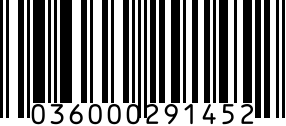
UPC signifie Universal Product Code (code universel de produit). C'est une symbologie de code-barres à 12 chiffres gérée par GS1 qui identifie un produit de façon unique dans le monde entier. Les 6 à 10 premiers chiffres identifient le fabricant (le préfixe d'entreprise GS1), les chiffres suivants identifient le produit précis, et le dernier chiffre est une clé de contrôle modulo 10 qui valide la lecture.
Si vous vendez sur Amazon, Walmart, Shopify ou tout grand distributeur d'Amérique du Nord, chaque référence (SKU) a besoin d'un UPC. Les distributeurs vérifient votre UPC dans la base de données mondiale GS1 pour confirmer qu'il provient bien du système GS1. Les UPC « ressemblants » auto-générés peuvent passer les contrôles de syntaxe mais échouent à la vérification du registre pour les fiches à fort enjeu.
Comment est structuré un code UPC
Un code-barres UPC-A standard encode 12 chiffres répartis ainsi : 1 chiffre de système de numérotation (identifie la catégorie de produit — « 0 » pour la plupart des biens de consommation, « 2 » pour les articles à poids variable, « 3 » pour les produits pharmaceutiques, « 4 » pour l'usage interne au magasin, « 5 » pour les coupons), 5 à 9 chiffres attribués par GS1 comme préfixe d'entreprise, les chiffres restants comme identifiant produit, et 1 clé de contrôle finale. La clé de contrôle est calculée modulo 10 à partir des 11 chiffres précédents — si elle est fausse, aucun scanner ne lira votre code.
Comment obtenir un code UPC (la voie GS1)
Tout vrai UPC provient du système GS1. Deux voies : licencier un préfixe d'entreprise auprès de l'organisation membre GS1 de votre pays — vous affectez alors des identifiants produit à chaque SKU dans l'espace de noms de votre préfixe — ou, pour des annonces marketplace standard, obtenir des codes vérifiés dérivés de GS1 sur notre page Acheter des codes UPC (dès 5 $). Les vendeurs en Brand Registry ont besoin de codes licenciés à leur propre nom — voir la FAQ de la page d'achat.
UPC vs UPC-A vs UPC-E
UPC-A est le code-barres standard à 12 chiffres présent sur la plupart des emballages de détail. UPC-E est une variante compressée à 8 chiffres pour les petits emballages (tubes de gloss, échantillons, mini barres chocolatées) où un UPC-A complet ne tient pas. UPC-E se décompresse en un UPC-A complet à 12 chiffres via un algorithme défini — ils représentent les mêmes données, simplement affichées différemment. La plupart des produits de consommation utilisent UPC-A ; seuls des SKU spécifiquement petits utilisent UPC-E.
Générateur d'UPC gratuit : quand est-ce acceptable ?
Générer ici un UPC-A syntaxiquement valide fonctionnera pour : le prototypage, le suivi de SKU interne, les fiches Etsy/eBay sous votre exemption GTIN existante, les produits enregistrés en Brand Registry, ou tout contexte où l'UPC n'a pas besoin de correspondre à une marque enregistrée dans la base GS1. Pour vendre sur Amazon et Walmart, il faut de vrais numéros issus du système GS1 — obtenez des codes vérifiés dérivés de GS1 sur notre page Acheter des codes UPC (dès 5 $).
FAQ
Comment trouver mon code UPC ?
Regardez au dos ou sous n'importe quel produit de détail — vous verrez un nombre à 12 chiffres imprimé sous un code-barres à barres verticales. Ce nombre EST l'UPC. Pour les produits que vous vendez, vos UPC attribués figurent dans votre compte du portail GS1 sous « Gérer les codes-barres » ou « Mes produits ».
Quelle est la différence entre SKU et UPC ?
Un SKU (unité de gestion de stock) est votre code produit interne — vous en choisissez le format, la longueur et le sens. Un UPC est un identifiant standardisé unique au monde émis par GS1 que tout distributeur peut scanner et relier à votre produit. Les SKU sont privés ; les UPC sont publics, enregistrés et liés à votre marque.
Comment obtenir un code UPC ?
Deux voies. Pour des annonces marketplace standard, obtenez des codes vérifiés dérivés de GS1 sur notre page Acheter des codes UPC (dès 5 $). Si vous avez besoin d'un préfixe d'entreprise à votre propre nom (Brand Registry, grandes gammes), demandez-le auprès de l'organisation membre GS1 de votre pays : GS1 vous attribue un préfixe unique et vous créez vos UPC dans cet espace de noms.
Puis-je créer mon propre code UPC ?
Techniquement oui — vous pouvez générer n'importe quel nombre à 12 chiffres avec une clé de contrôle valide (essayez notre générateur ci-dessus). Mais pour un usage commercial, le numéro doit provenir du système GS1 — Amazon, Walmart, Target et Google Shopping vérifient la base GS1 et rejettent les UPC « auto-créés ». N'utilisez les UPC générés que pour des scénarios internes/prototype/exemptés ; pour le commerce de détail, obtenez de vrais codes dérivés de GS1 sur notre page Acheter des codes UPC (dès 5 $).
Où consulter un code UPC ?
Les recherches publiques gratuites incluent UPC Lookup (upcitemdb.com), Barcode Lookup (barcodelookup.com) et le portail Verified by GS1 sur gs1.org/services/verified-by-gs1. La recherche GS1 fait foi — si un UPC n'y figure pas, il n'est pas officiellement enregistré.
Qu'est-ce qu'un UPC dans la musique ?
Dans l'industrie musicale, UPC désigne le même code universel de produit à 12 chiffres, utilisé pour identifier une sortie musicale (album, single, EP) chez les distributeurs numériques et physiques comme Apple Music, Spotify, Amazon Music et les CD. DistroKid, CD Baby et d'autres distributeurs musicaux attribuent généralement un UPC à chaque sortie, ou vous pouvez fournir le vôtre.
Related generators
Need a real barcode now?
Generate a valid UPC-A barcode in seconds, no watermark. Free for casual use; paid plans from $9/mo for higher volume.