
Home · Learn · Qu'est-ce qu'un GTIN ? Les numéros article internationaux expliqués
Qu'est-ce qu'un GTIN ? Les numéros article internationaux expliqués
GTIN est la famille d'identifiants produit émis par GS1 — UPC-A est un GTIN-12, EAN-13 est un GTIN-13. Voici ce que signifie GTIN, son lien avec les codes-barres et comment en obtenir un.
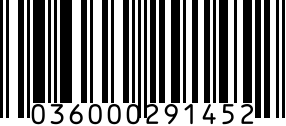
GTIN signifie Global Trade Item Number (numéro article international). C'est un identifiant produit unique au monde émis par GS1 — l'organisation qui gère le système de codes-barres. Il existe quatre formats : GTIN-8 (utilisé pour EAN-8 sur les petits emballages), GTIN-12 (utilisé pour UPC-A en Amérique du Nord), GTIN-13 (utilisé pour EAN-13 à l'international) et GTIN-14 (utilisé pour ITF-14 sur les caisses et cartons).
Chaque fois que vous voyez un code-barres sous un produit en rayon, le nombre imprimé en dessous EST le GTIN. UPC et EAN sont deux formats de GTIN précis — dire « il me faut un UPC » et « il me faut un GTIN-12 » signifie la même chose. Les places de marché comme Amazon, Walmart, Google Shopping et Meta Commerce parlent toutes de « GTIN » alors qu'elles désignent en réalité l'un de ces identifiants GS1.
GTIN-8, GTIN-12, GTIN-13, GTIN-14 : lequel me faut-il ?
La plupart des produits de détail en Amérique du Nord utilisent GTIN-12 (UPC-A). Les produits internationaux utilisent GTIN-13 (EAN-13). Les très petits emballages qui ne peuvent pas accueillir un UPC complet utilisent GTIN-8 (EAN-8) — pensez aux mini barres chocolatées et aux échantillons de cosmétiques. Les caisses et cartons d'expédition utilisent GTIN-14 (ITF-14). En interne, les distributeurs stockent chaque GTIN sur 14 chiffres avec des zéros de tête, donc un UPC-A « 012345678905 » est stocké comme GTIN-14 « 00012345678905 ».
Comment obtenir un GTIN auprès de GS1
Faites la demande auprès de l'organisation membre GS1 de votre pays. GS1 vous attribue un préfixe d'entreprise, puis vous créez des GTIN dans l'espace de noms de ce préfixe ; les tarifs varient selon le pays et le nombre de GTIN. Pour quelques codes destinés à des annonces marketplace standard, notre page Acheter des codes UPC propose des GTIN vérifiés dérivés de GS1 dès 5 $. Chaque GTIN est lié de façon unique à une variante de produit (taille, couleur, parfum) et ne peut pas être réutilisé.
GTIN vs SKU vs code-barres : clarifier la terminologie
SKU = votre code produit interne, votre format, votre entreprise. GTIN = l'identifiant mondial émis par GS1 et enregistré à votre marque. Code-barres = la représentation visuelle scannable du GTIN (barres UPC-A, barres EAN-13, grille Data Matrix, etc.). Un même GTIN peut être rendu sous plusieurs types de codes-barres — le même GTIN-13 peut apparaître en EAN-13 sur la face du produit ET en ITF-14 sur le carton maître, les deux codes-barres encodant le même nombre sous-jacent.
Où le GTIN compte le plus : Amazon et Google Shopping
Google Merchant Center (le back-office de Google Shopping) exige un GTIN valide pour presque chaque fiche produit — Google vérifie le GTIN dans la base GS1 avant d'approuver les annonces. Amazon exige un GTIN pour créer de nouvelles fiches dans la plupart des catégories. Sans un GTIN réel et enregistré chez GS1, vos produits sont fonctionnellement invisibles dans le commerce de détail moderne.
FAQ
Comment obtenir un numéro GTIN ?
Deux voies. Pour des annonces marketplace standard, obtenez des GTIN vérifiés dérivés de GS1 sur notre page Acheter des codes UPC (dès 5 $). Pour un préfixe d'entreprise à votre propre nom, demandez-le auprès de l'organisation membre GS1 de votre pays : après enregistrement, GS1 vous attribue un préfixe et vous créez vos GTIN dans cet espace de noms.
SKU et GTIN sont-ils identiques ?
Non. Le SKU est votre code produit interne — vous en choisissez le format et le sens. Le GTIN est un identifiant standardisé au monde émis par GS1 et enregistré à votre marque. Les SKU sont privés et propres à la marque ; les GTIN fonctionnent chez tous les distributeurs du monde.
Le GTIN est-il identique au code-barres ?
Étroitement lié mais pas identique. Le GTIN est le nombre ; le code-barres est la représentation visuelle scannable de ce nombre. Le même GTIN peut être rendu en code-barres UPC-A, EAN-13, ITF-14 ou même en Data Matrix 2D. Le code-barres « enveloppe » le GTIN.
Qui émet les numéros GTIN ?
GS1 est le seul émetteur officiel. Il existe des bureaux GS1 dans presque chaque pays — GS1 US, GS1 UK, GS1 Germany, GS1 India, etc. Vous faites la demande auprès du bureau de votre pays d'activité. Les revendeurs tiers détiennent d'anciens préfixes GS1 et en revendent des numéros : ces codes dérivés de GS1 fonctionnent pour les annonces marketplace standard, mais les fiches en Brand Registry exigent des codes licenciés au nom propre du vendeur.
Puis-je obtenir un GTIN gratuitement ?
La plupart des pays ne proposent plus de GTIN gratuits à grande échelle, même si certains bureaux GS1 offrent un GTIN unique de démarrage aux très petites entreprises. L'outil de création de GTIN en ligne de GS1 est gratuit une fois votre préfixe payé. Les « générateurs de GTIN » gratuits qui ne passent pas par GS1 ne sont pas de vrais GTIN — ils génèrent des nombres syntaxiquement valides mais ne passent pas la vérification Amazon ou Google Shopping.
Combien coûte un GTIN ?
Cela dépend de la voie. Sur notre page Acheter des codes UPC, des GTIN vérifiés dérivés de GS1 démarrent à 5 $ pièce, sans frais annuel. Licencier votre propre préfixe d'entreprise auprès de l'organisation membre GS1 de votre pays coûte davantage — tarification par paliers selon le nombre de GTIN et le pays, souvent avec renouvellement annuel.
Related generators
Need a real barcode now?
Generate a valid UPC-A barcode in seconds, no watermark. Free for casual use; paid plans from $9/mo for higher volume.